 DVDneXtCOPY DVD Ripper
How to Use MakeMKV to Rip DVD and Blu-ray in 2026

Summary: MakeMKV remuxes selected DVD and Blu-ray video, audio, subtitles, and chapters into MKV without normal video re-encoding. It can generally rip DVDs and standard Blu-rays offline, while some 4K UHD discs may need internet access for a hashed-key update. This guide covers setup, title selection, ripping, output verification, and common MakeMKV errors.
Table of Contents
MakeMKV Current Status
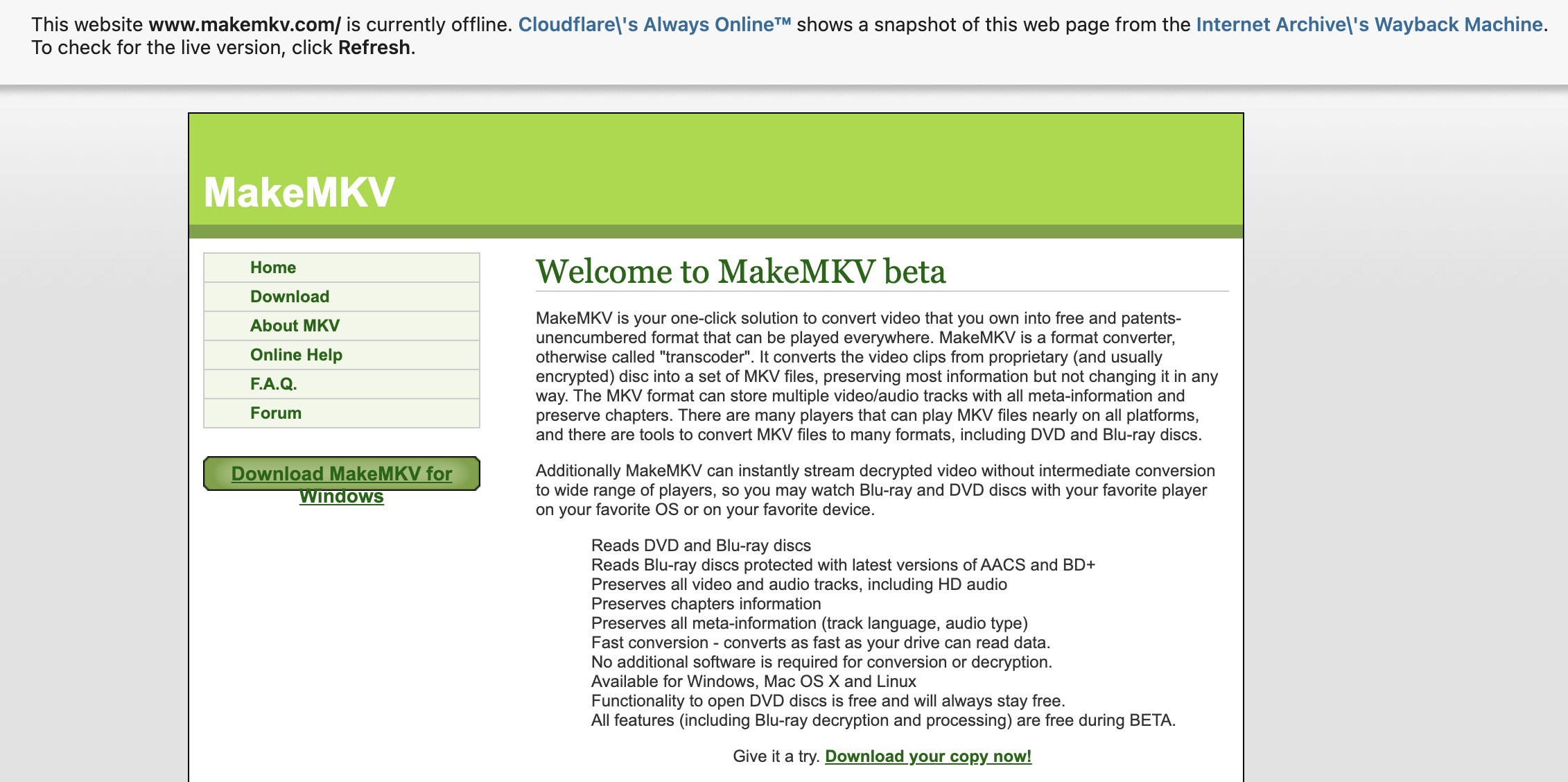
MakeMKV is a disc-ripping and backup tool for DVD, Blu-ray, and supported UHD workflows. The current release is MakeMKV 1.18.4, released on June 15, 2026. Windows and macOS builds are available from the official download page, while Linux builds are distributed through the MakeMKV forum.
| Item | Current Status |
|---|---|
| Current version | MakeMKV 1.18.4 |
| Normal title-ripping output | MKV |
| DVD functionality | Freeware functionality |
| Blu-ray functionality | Beta/shareware registration rules apply |
| DVD / standard Blu-ray offline use | Generally works offline |
| 4K UHD offline use | Some UHD discs may require a hashed-key download |
| Platforms | Windows, macOS, Linux |
What Does MakeMKV Actually Do?
MakeMKV opens a DVD or Blu-ray, analyzes the titles on the disc, and lets you choose which video, audio, subtitle, chapter, and metadata streams to keep. Each selected title is then saved as an MKV file. This makes the program especially useful for preserving movie or episode streams without first converting them to a different video codec.
A normal MakeMKV title rip does not preserve the original interactive disc menu. Instead, it creates individual MKV files for selected movies, episodes, or bonus titles. MakeMKV also includes separate disc-backup functions, but the workflow below focuses on ripping selected titles to MKV.
MakeMKV Remux vs Video Transcoding
In its normal title-ripping workflow, MakeMKV behaves more like a remuxer than a traditional video encoder. It transfers the existing compressed video, audio, and subtitle streams from the source disc into an MKV container without normally re-encoding the video.
A transcoding workflow is different. A transcoder decodes the source video and encodes it again as H.264, HEVC, or another codec. That can substantially reduce file size, but it also requires another encoding step.
This distinction explains two important MakeMKV characteristics: the output can remain very close to the source streams, and normal ripping speed is not primarily determined by GPU video-encoding performance. Disc-reading speed is often the more important bottleneck.
What Does MakeMKV Keep from a DVD or Blu-ray?
| Disc Content | Normal MakeMKV Title Rip |
|---|---|
| Main movie | Yes |
| TV episodes | Yes, when available as selectable titles |
| Multiple audio tracks | Selectable |
| HD / lossless audio | Can be retained |
| Subtitles | Selectable |
| Chapters | Retained |
| Bonus titles | Selectable |
| Language metadata | Retained |
| Original interactive disc menu | Not retained in a normal MKV title rip |
Track selection matters because every retained audio or subtitle stream adds data to the finished file. Keeping the main audio, required subtitles, and any commentary or alternate-language tracks you actually use can make the library easier to manage without changing the source video.
Can MakeMKV Work Offline?
Yes, MakeMKV can generally rip DVDs and standard Blu-rays without an active internet connection. The main exception is 4K UHD, where MakeMKV may need to download hashed-key information before an unfamiliar disc can be opened.
Offline disc processing is separate from downloading MakeMKV, updating the program, checking registration status, or obtaining current beta-registration information. Those tasks may still require internet access even when the actual DVD or Blu-ray rip does not.
Using MakeMKV Offline for DVD
DVD is the simplest offline case. MakeMKV's DVD-opening functionality is freeware, and normal DVD reading does not rely on the UHD hashed-key system. Once the program is installed, a DVD can generally be inserted, analyzed, and saved to MKV without maintaining an internet connection.
Using MakeMKV Offline for Blu-ray
Standard Blu-ray ripping can also generally operate offline when MakeMKV is already in a valid registration state. Registration and disc reading are separate parts of the workflow, so an expired evaluation or registration message should not be mistaken for a network requirement caused by the Blu-ray itself.
Why 4K UHD May Need Internet Access
4K UHD is different because MakeMKV uses hashed-key information for supported UHD discs. If the required key is not already available locally, MakeMKV may need internet access to obtain updated key data before the disc can be opened.
Once the required hashed key for that disc is stored locally, the same disc may work offline later. This means offline UHD support depends on whether the information needed for that particular disc has already been obtained.
How to Use MakeMKV to Rip a DVD or Blu-ray
The normal MakeMKV workflow is straightforward: install the program, open the source, select the titles and tracks you want, choose an output folder, and create the MKV files. The title-selection step deserves the most attention because choosing the wrong playlist, episode, audio track, or subtitle can mean repeating the rip.
Step 1: Download and Install MakeMKV
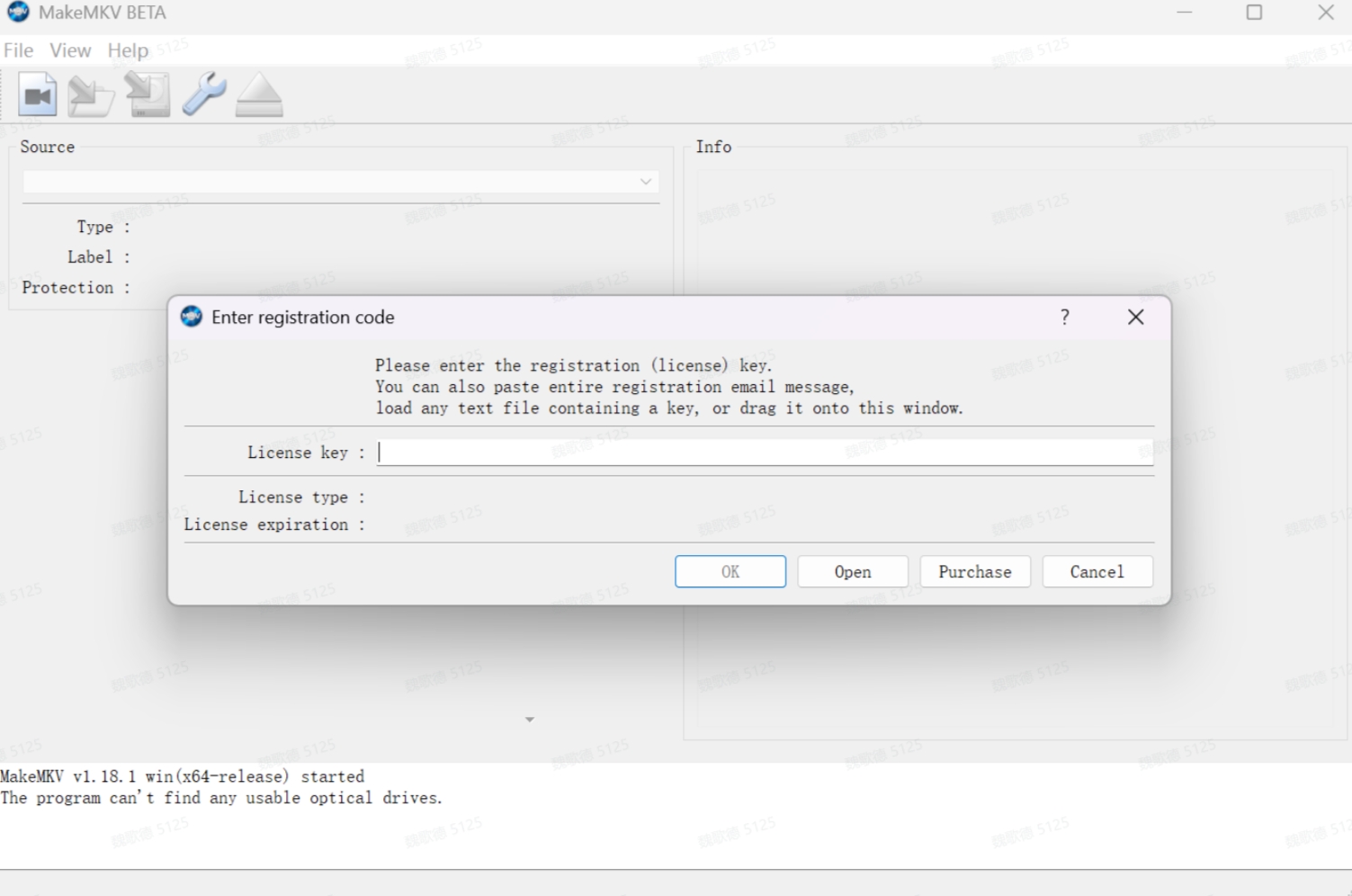
Download the current version from the official MakeMKV website and install the appropriate build for your operating system. MakeMKV 1.18.4 is currently available for Windows and macOS, while Linux builds are provided through the official forum.
Use disc-copying functions only with media you own or are authorized to process, subject to the copyright rules that apply in your location.
Step 2: Load the DVD, Blu-ray, ISO, or Disc Backup
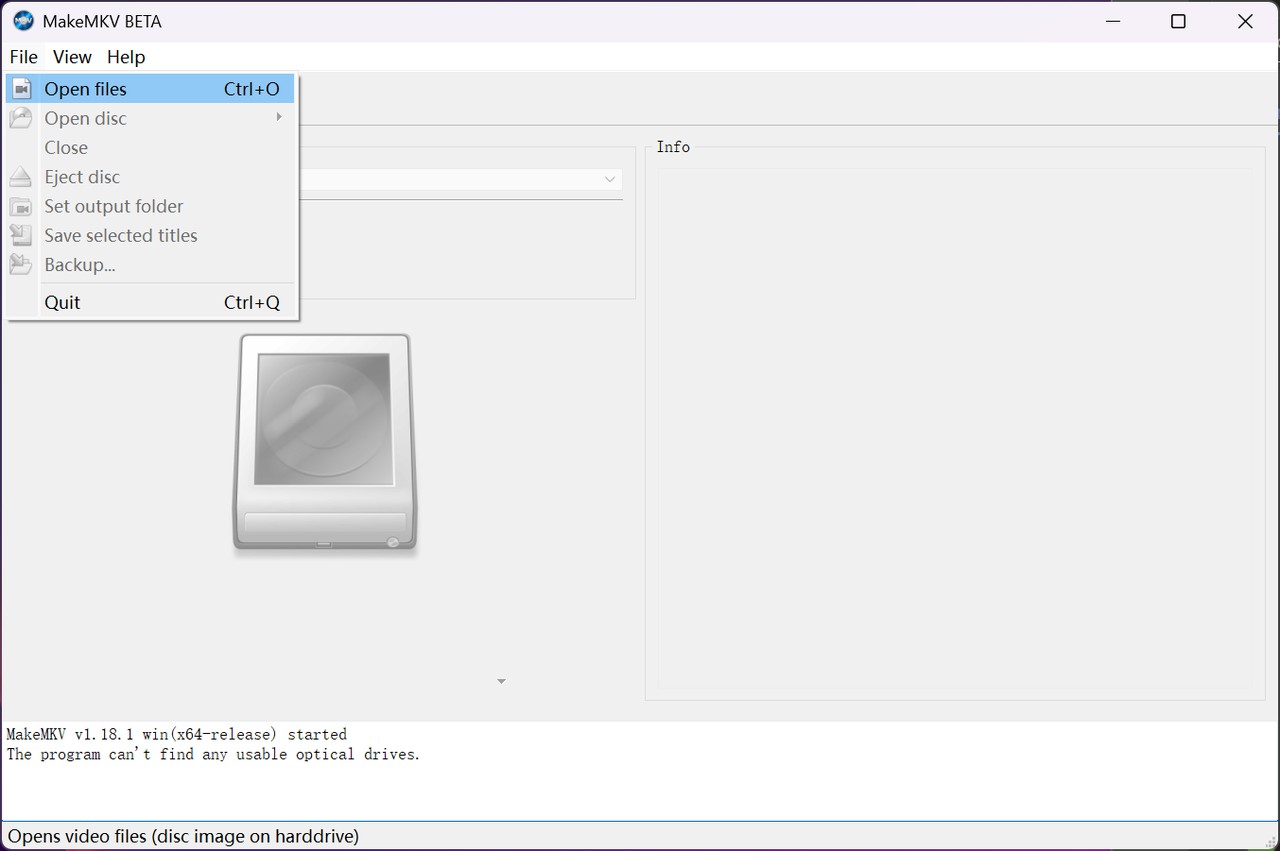
Launch MakeMKV and insert a physical DVD or Blu-ray into an internal or external optical drive. The main interface displays detected drives. Select the source drive and open the disc so MakeMKV can analyze its structure.
MakeMKV can also work with compatible sources already stored on a hard drive, including ISO images and supported disc-backup structures. After the source opens, the program displays the available titles in a tree view.
Step 3: Select the Correct Title, Audio, and Subtitles
Expand the title list to see the available video, audio, and subtitle streams. MakeMKV displays information such as size, runtime, codec, and language to help identify the movie, TV episodes, trailers, and bonus material.
For a feature film, runtime is a useful clue, but the longest title should not automatically be treated as the correct movie. Some discs contain alternate cuts, duplicate playlists, or deliberately misleading title structures.
For a TV-series disc, look for several titles with similar runtimes and sizes. Select the episodes you need and expand each title to choose the required audio and subtitles.
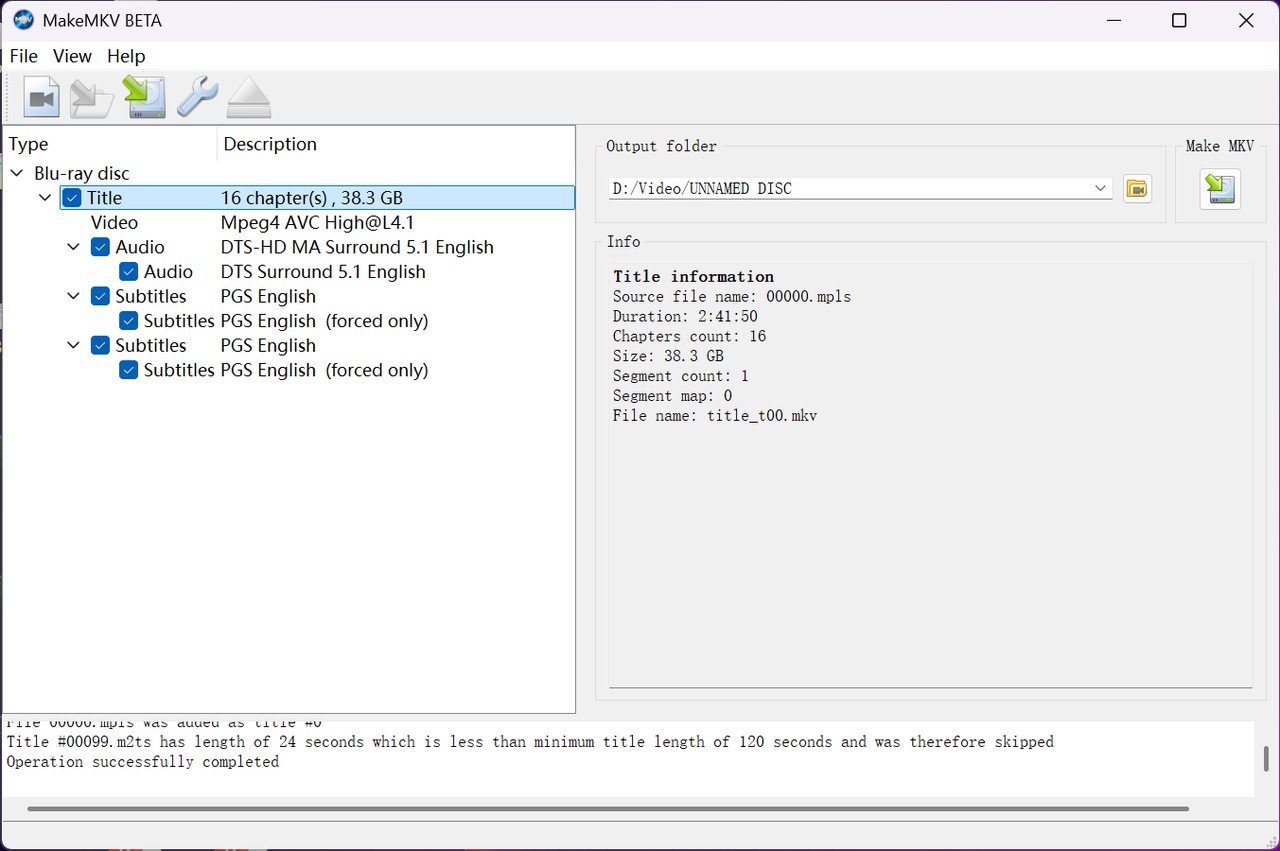
Uncheck tracks you do not need, such as unused commentary, duplicate languages, or unnecessary subtitles. Removing those streams can reduce the finished file size without re-encoding the main video.
Step 4: Choose an Output Folder and Start the Rip
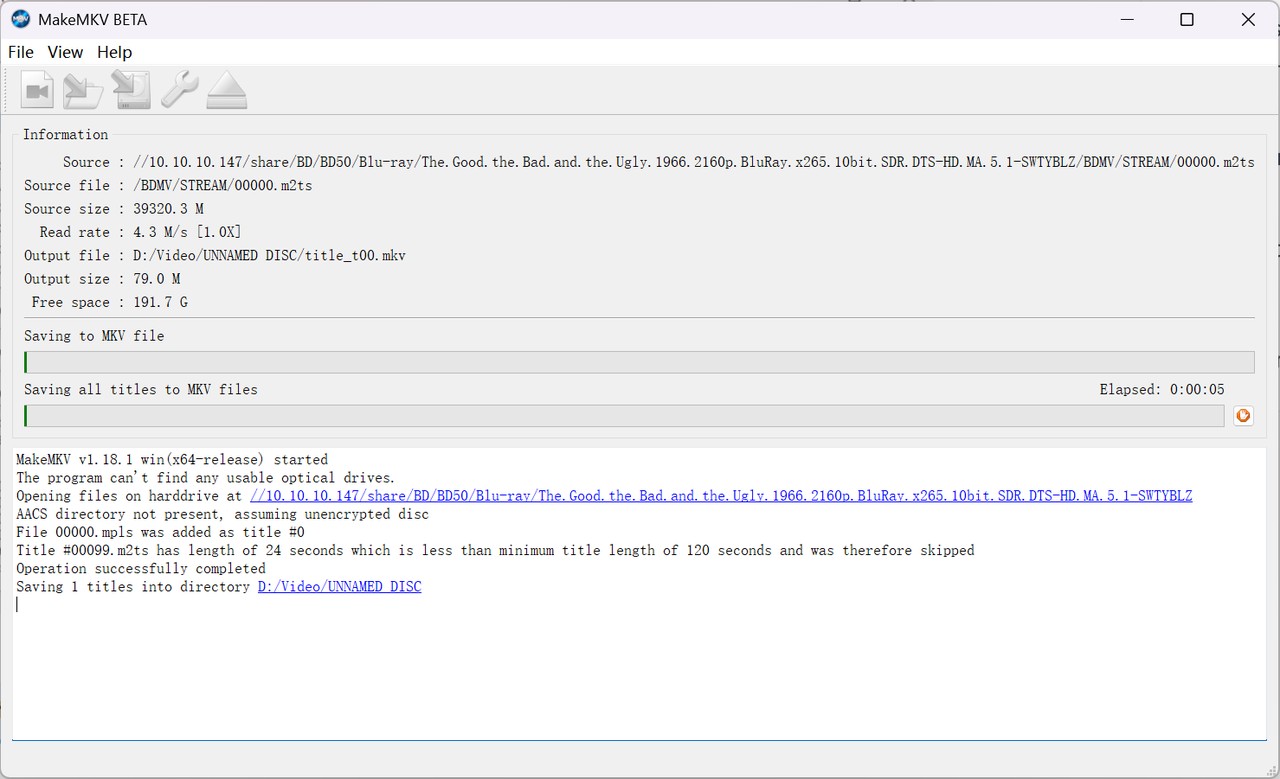
Choose the destination folder and click Make MKV. MakeMKV then reads the selected source streams and writes them into MKV files.
There is no single reliable ripping time for every DVD or Blu-ray. Processing speed depends heavily on how quickly the optical drive can read the source, how much data is selected, the condition of the disc, read retries, the connection used by an external drive, and the destination storage device.
Step 5: Verify the Finished MKV
After MakeMKV finishes, open the MKV before archiving the physical disc. Check the total runtime and play sections near the beginning, middle, and end.
Also verify:
- The correct movie or episode was ripped.
- The primary audio language plays correctly.
- Any commentary or alternate audio you wanted is present.
- Required subtitles are available.
- Chapter navigation works.
- Audio and video remain synchronized.
TV-series discs deserve extra attention because the order of the generated files may not match the broadcast episode order. Rename files only after confirming which episode each title contains.
Does MakeMKV Reduce Video Quality?
Under its normal title-ripping workflow, MakeMKV does not perform the usual lossy video re-encoding step. The compressed video stream from the DVD, Blu-ray, or UHD source is placed in the MKV container instead of being encoded again as a new H.264 or HEVC stream.
This avoids the generation loss associated with another lossy video encode. It does not improve the source, however. A standard-definition DVD remains standard definition, film grain remains visible, and MakeMKV does not create new picture detail by placing the video inside an MKV container.
Selected source audio can also be retained, including HD and lossless audio streams when present on the disc. Playback compatibility still depends on whether the device or media player supports the codec stored inside the MKV.
Why Are MakeMKV Files So Large?
MakeMKV files can be large because the main video is normally retained at its source bitrate rather than recompressed into a smaller delivery file.
The finished size is largely determined by the selected streams on the original disc. Removing unused commentary, foreign-language audio, subtitles, and bonus titles can save some storage, but it does not substantially reduce the bitrate of the main video.
As a result, Blu-ray and UHD MKVs can require considerably more space than a heavily compressed MP4 or HEVC transcode. Large output files are therefore a normal consequence of MakeMKV's source-stream workflow rather than evidence that the rip has failed.
Common MakeMKV Problems and Fixes
MakeMKV Says "No Disc Inserted"
Start by confirming that the operating system can see the optical drive. Then try the following:
- Eject and reinsert the disc.
- Close and reopen MakeMKV.
- Reconnect an external optical drive.
- Try another USB port or cable.
- Restart the computer if the drive is still missing.
If several known-good discs fail in the same drive but work in another drive, the problem is more likely to involve the optical drive or its connection than MakeMKV's title settings.
MakeMKV Fails to Open a Disc
Inspect both the disc and the MakeMKV log before repeatedly starting the same job. Common checks include:
- Clean fingerprints or dust from the disc.
- Check for scratches or visible physical damage.
- Update to the current MakeMKV version.
- Review the log for repeated read errors.
- Try another optical drive if one is available.
A disc that cannot be read reliably by the optical drive cannot normally be repaired by changing the MKV output settings.
"The Volume Key Is Unknown for This Disc" on 4K UHD
This error is associated with UHD key handling rather than video encoding. When MakeMKV does not have the required information for a particular UHD disc, it may create an AACS dump and require updated key data before the disc can be opened.
Check that:
- MakeMKV is up to date.
- Enable Internet access is enabled when a hashed-key update is needed.
- The UHD optical drive is compatible with the intended MakeMKV workflow.
- The program can access updated hashed-key information.
If the log reports that automatic hashed-key downloading is disabled or failed, resolve that issue before troubleshooting video or audio output settings.
Why Does MakeMKV Show So Many Titles on a Lionsgate Disc?
Some Lionsgate releases use playlist obfuscation, also known as Screen Pass-style protection. A disc can present dozens or even hundreds of similar titles or playlists even though only one sequence represents the intended main movie.
Do not assume the first or longest title is always correct. Compare:
- Runtime
- Chapter sequence
- Playlist information
- Audio and subtitle tracks
- The playback order on the physical disc
- Information for the exact regional or retail edition when necessary
When Java is available for supported Blu-ray structures, MakeMKV may identify a likely main feature and label it accordingly, but this is still a best-match result rather than a guarantee. Retail, rental, and regional releases can use different playlists.
Why Is MakeMKV Ripping So Slowly?
Normal MakeMKV ripping does not rely on a full GPU video-encoding process, so the absence of GPU encoding is not by itself a good explanation for a slow rip.
Common bottlenecks include:
- Optical-drive read speed
- Repeated retries on marginal or damaged sectors
- A scratched or dirty disc
- An external USB connection
- The amount of data on a Blu-ray or UHD disc
- Slow destination storage
If the MakeMKV log repeatedly shows read errors, troubleshooting the physical disc, optical drive, or connection is more useful than changing video-encoding settings.
When MakeMKV Isn't the Right Workflow
MakeMKV is a strong fit when the goal is to retain source video, audio, subtitles, and chapters in an MKV container. It is less direct when the target is a much smaller file, direct MP4 output, device-specific video encoding, or built-in editing, because those tasks require transcoding or additional processing.
A DVD-Focused Option: DVDneXtCOPY DVD Ripper
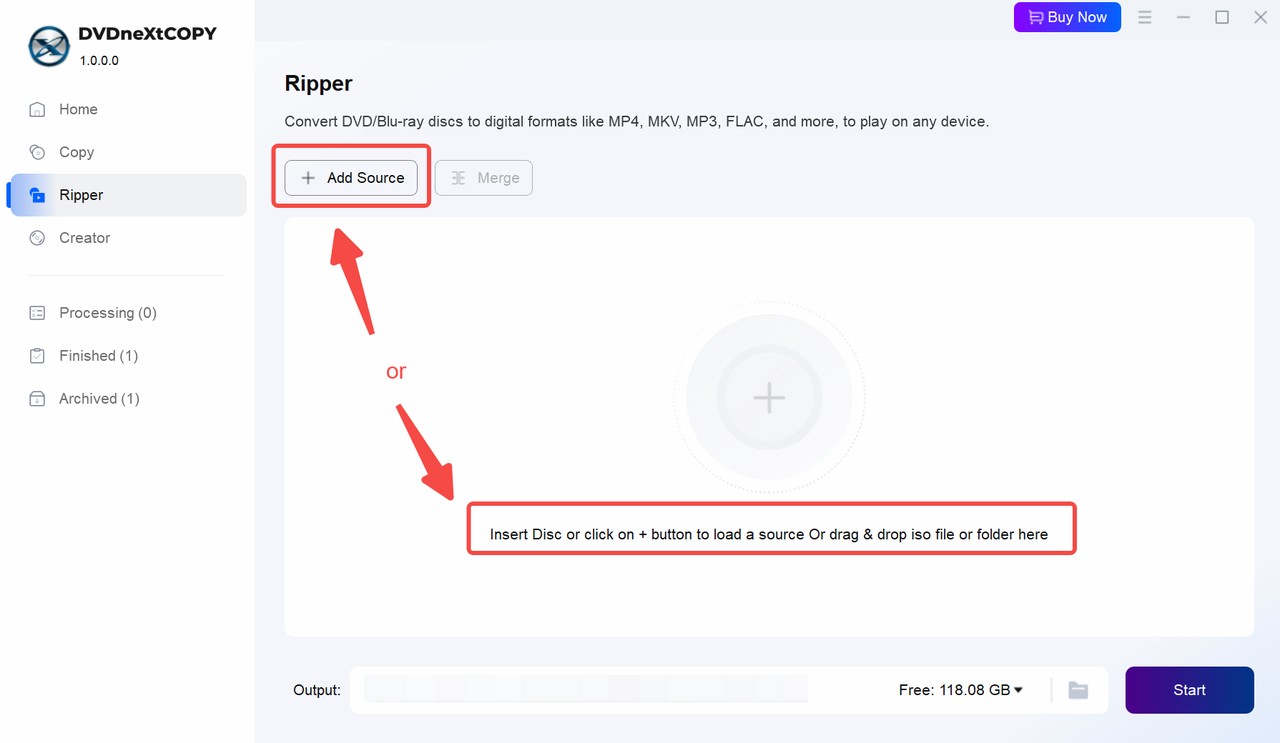
For DVD users who want a more conversion-oriented workflow, DVDneXtCOPY DVD Ripper can load a protected DVD, ISO image, or DVD folder and convert selected content to formats such as MP4 or MKV. It also provides title and chapter selection, audio and subtitle controls, advanced video and audio settings, and built-in editing tools such as trim, crop, and merge.
The key difference is the workflow. MakeMKV is primarily suited to remuxing selected disc streams into MKV, while DVDneXtCOPY DVD Ripper also supports re-encoding for direct MP4 and other playback-oriented outputs when smaller files, device compatibility, or editing matter more.
For a broader comparison of tools and workflows, see the MakeMKV alternatives guide. It covers compression, direct MP4 output, editing, and other disc-processing options without changing this page's focus on how to use MakeMKV.
FAQs
Yes, when the disc presents each episode as a separate title. Select the episode titles you want and MakeMKV can create separate MKV files. Some discs author several episodes as one long title; in that case MakeMKV may produce one combined MKV, which can be split afterward with a chapter- or time-based tool such as MKVToolNix.
MakeMKV normally retains the selected source audio stream rather than automatically converting it to a lossy format. If the disc contains a TrueHD/Atmos, DTS-HD, or other lossless track and that stream is selected, it can remain in the MKV. Actual Atmos or lossless playback still depends on whether the media player, TV, soundbar, or AV receiver can correctly decode or bitstream that audio from an MKV container.
Not through the normal title-ripping workflow. MakeMKV is primarily designed to save selected titles rather than arbitrary individual chapters. If only certain chapters are needed, create the title MKV first and then split or remux it afterward with a chapter-aware tool such as MKVToolNix.
MKV is a container, so support for the .mkv extension does not guarantee support for every video, audio, subtitle, or HDR format stored inside it. A TV may support H.264 video in MKV but reject a particular Blu-ray video codec, lossless audio format, subtitle type, or HDR profile. Check the TV's codec specifications as well as its MKV container support.
Conclusion
MakeMKV remains a practical tool in 2026 for moving selected DVD and Blu-ray titles into MKV while keeping the source video stream and the audio, subtitle, chapter, and metadata tracks you choose. Its remux-style workflow avoids a normal second video encode, but that also means the resulting files can remain large.
For ordinary DVD and standard Blu-ray use, MakeMKV can generally operate offline. Some UHD discs are more complicated because they may require hashed-key information, while difficult discs can also be affected by optical-drive read errors, physical damage, or complex playlist structures such as those found on some Lionsgate releases.
![Top 8 Best MP4 to DVD Converters on Windows & Mac [2026 Tested]](https://images.dvdnextcopy.com/2026/09/17/I2v69nzxIF6Xn7iue3ZRMGJ5-Ls0SF_z/feature_cover.jpg) Luna MillerSep 21, 2026
Luna MillerSep 21, 2026Top 8 Best MP4 to DVD Converters on Windows & Mac [2026 Tested]
 Luna MillerSep 21, 2026
DVD Region Codes Explained: Region 1 and Playback Options
![How to Remove DVD Copy Protection: Software and Free Methods [2026]](https://c.dvdnextcopy.com/media/How_to_Remove_DVD_Copy_Protection_d24c38a790.png) Steven VanceSep 21, 2026
Steven VanceSep 21, 2026How to Remove DVD Copy Protection: Software and Free Methods [2026]
 Luna MillerSep 21, 2026
How to Rip a Copy-Protected DVD on Win & Mac: 6 Ways
 Steven VanceSep 18, 2026
Top MP4 to ISO Converter in 2026: DVD Authoring vs Online Tools
 Steven VanceSep 18, 2026
How to Digitize DVD Collection: 5 Ways in 2026