 DVDneXtCOPY DVD Ripper
DVD Region Codes Explained: Region 1 and Playback Options

Summary: DVD region codes can frustrate you by limiting the content to a particular geographic area. However, bypassing region codes or other copy protections allows you to watch the DVD content from any region. This guide aims to explore everything about DVD region codes and how to bypass them so they can be played on any player.
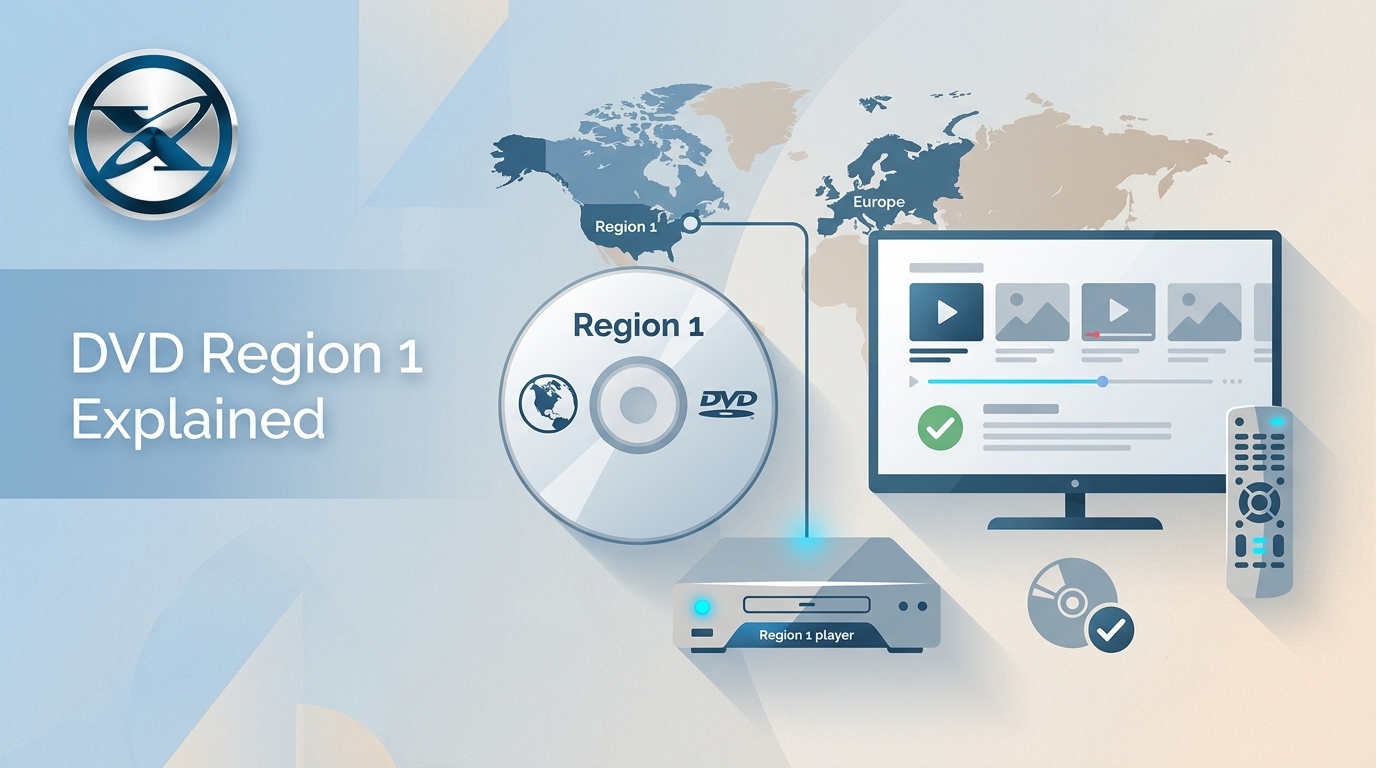
When I check an imported DVD, I start with its region label and the player model, not the seller’s location. A DVD region code identifies intended playback markets. Region 1 covers the United States, Canada, and U.S. territories; check the disc and player before buying.
DVD Region Codes and Region 1 Explained

DVD region codes were introduced in 1997 as a digital rights management (DRM) measure designed to control the distribution of DVDs across different global markets. Region codes help distributors control DVDs' release schedule, pricing, and availability in various markets. DVD players are region-locked, meaning they will only play discs encoded for their specific region, preventing unauthorized access to content released in different parts of the world.
The DVD world is divided into six primary regions, with two additional special-use areas. Every DVD is assigned a specific region code that determines where it can be played. For instance, a Region 1 DVD, meant for the U.S. and Canada, will only work on players set to that region. Region 0 or ALL DVDs can often play across regions, but RCE, PAL/NTSC, and device compatibility can still affect playback. Some models offer documented region settings; follow the instructions for the exact model.
If you try to play a DVD from a different region, you'll encounter an error message, such as "ERROR: Playing Of This Disc Prohibited By Area Limits." Understanding region codes is essential to ensure compatibility between DVDs and players across different regions.
Let us delve into all the available DVD region codes for deeper insights.
Region 1 Quick Answer
A Region 1 DVD is intended for the United States, Canada, and U.S. territories. Check the globe mark on the disc or case before buying or importing it. In my experience with physical-disc compatibility, that label is more useful than the seller’s country because a marketplace listing may not identify the disc’s actual region.
DVD Region Code Chart
| DVD Region Codes | Different Regions |
|---|---|
| Region 1 | Canada, the United States, and all the U.S. territories |
| Region 2 | Japan, Europe (e.g., the U.K.), South Africa, the Middle East (including Egypt), and Greenland |
| Region 3 | South East Asia and East Asia (including Hong Kong) |
| Region 4 | Australia, New Zealand, the Pacific Islands, Central/Latin America, Mexico, South America, and the Caribbean |
| Region 5 | Eastern Europe, Russia, the Indian Subcontinent, Africa, North Korea, and Mongolia |
| Region 6 | China |
| Region 7 | Reserved for unspecified special use |
| Region 8 | Special international venues for air and oceanic travel, such as cruise ships, airlines, and spacecraft |
| Region 0 or Region ALL | Uncoded or all-region discs |
Region 0 and Region ALL: These labels generally identify an uncoded or all-region DVD. Region Code Enhanced (RCE) discs, PAL/NTSC differences, and device-specific restrictions can still affect compatibility.
Why DVD Region Codes Exist: Purpose and Impact
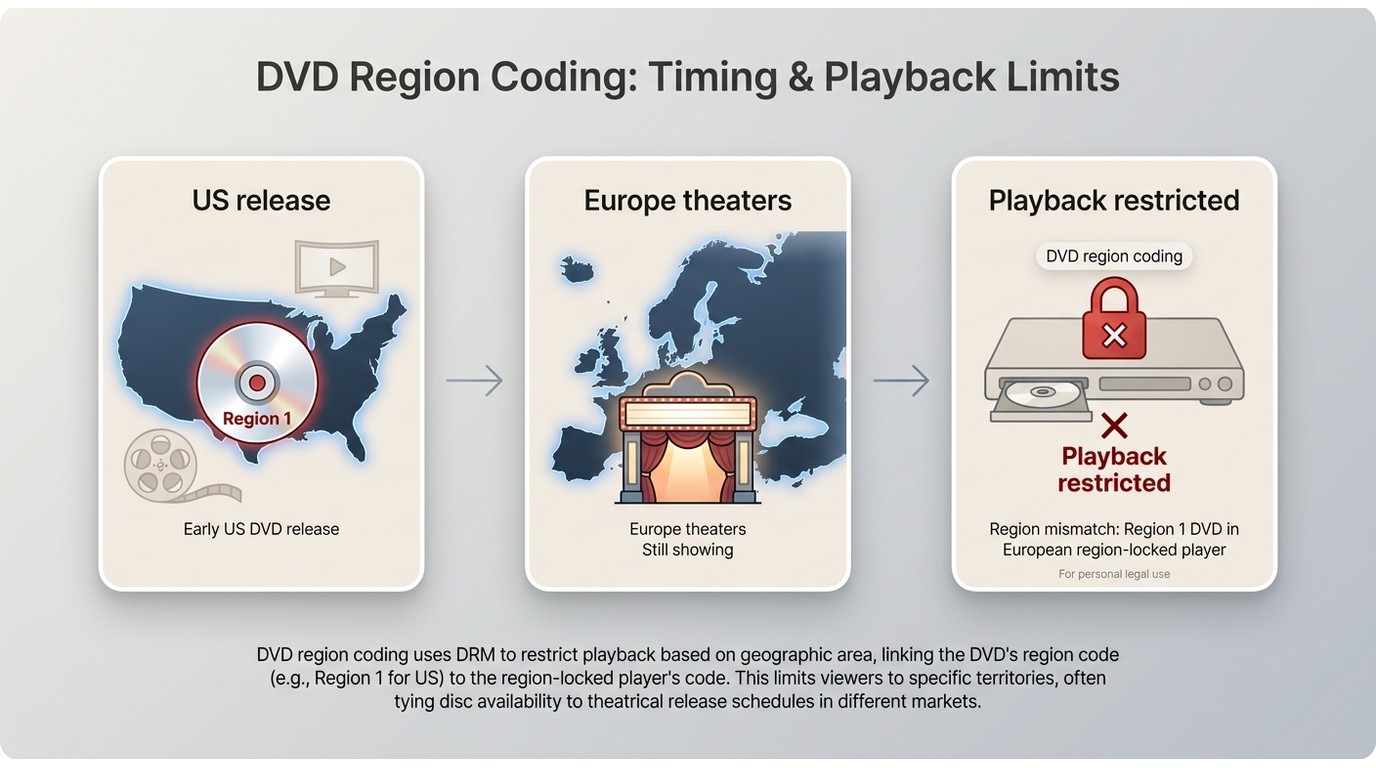
Purpose of DVD Region Codes
DVD region codes were introduced by movie studios and distributors to control the international release of movies. The primary goal is to manage when and where films become available on DVD to maximize profits and maintain control over the distribution process.
This system prevents a DVD from being played in a region where the movie hasn’t been officially released. For example, a film may be out on DVD in the U.S. while still running in theaters in Europe. Without region codes, consumers could easily purchase a cheaper version from another region, undercutting local distributors and reducing potential revenue.
Additionally, copyright laws vary by country, and region coding helps ensure movie studios can enforce their rights according to local legal frameworks. Overall, DVD region codes regulate distribution, protect profits, and safeguard the legal interests of the film industry.
Consumer Compatibility Limits
For the film industry, region codes not only help prevent unauthorized distribution across regions, but also protect the value chain of film distribution, from theatrical release to DVD release to digital files.
Region coding controls where a disc is intended to play, while the player and video-system compatibility can also affect the result. NTSC vs. PAL compatibility is separate from DVD region coding, so matching one does not guarantee that the other will work.
For import buyers, the cost often appears after purchase: the disc, player, and display standard all need to align. I would check those three items before changing a device setting or ordering dedicated hardware.
Find a DVD's Region Code
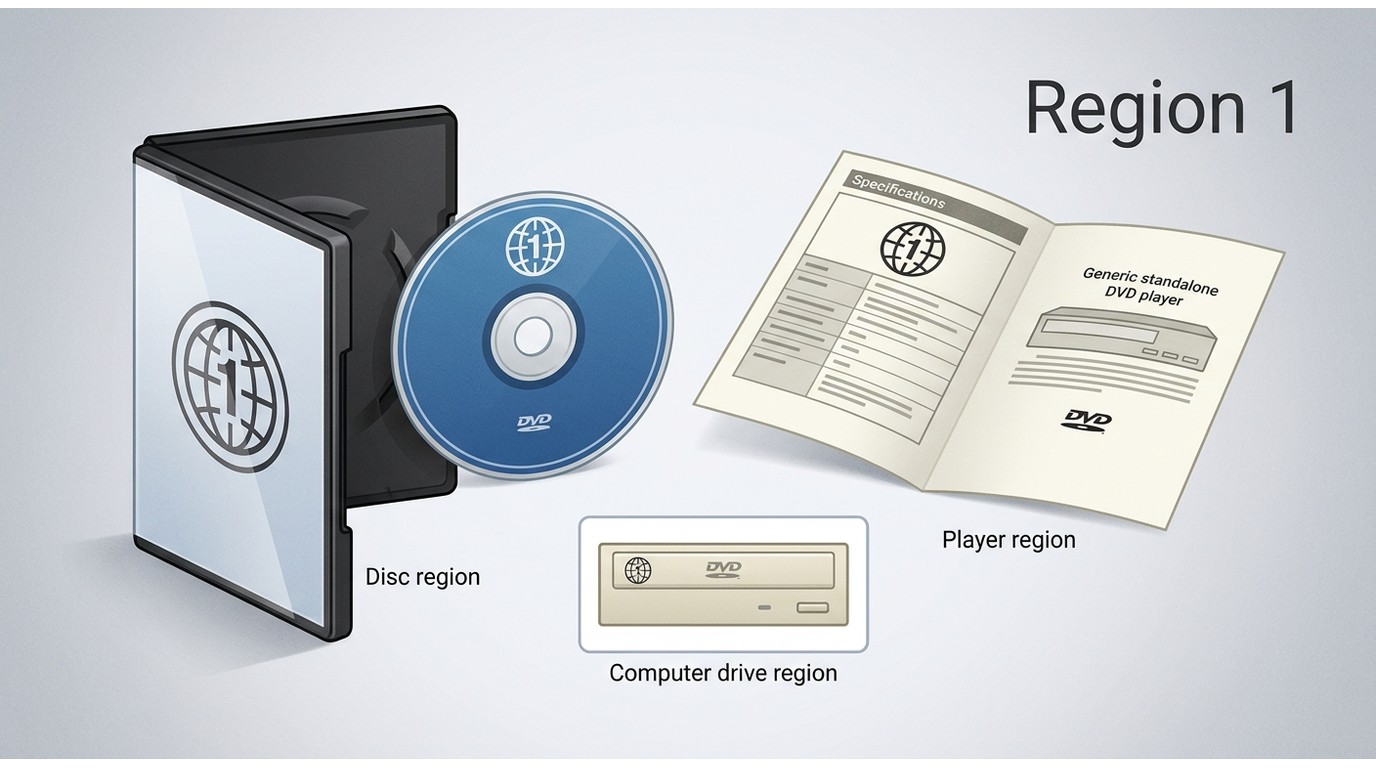
Check the region mark on the disc or case and confirm the exact player model’s supported DVD regions before purchase or playback. This is especially important when an imported disc will be used with a region-locked computer drive or standalone player.
Start with the packaging. Look near the barcode for the small globe icon and its number. Check the disc label too, then compare that number with the exact player model’s DVD region support. A listing that says “multi-region” without naming supported DVD regions deserves extra caution.
If the label is missing, inspect the product listing, publisher details, and the player manual before importing the disc. Also confirm whether a “region-free” claim refers to DVDs, Blu-ray discs, or both, because those formats use different regional systems.
Once you know the disc and device regions, compare the available playback options before changing any settings. A local copy created with DVDneXtCOPY DVD Ripper is one option for legally owned discs and personal viewing where local law permits.
DVD Region Workarounds Compared
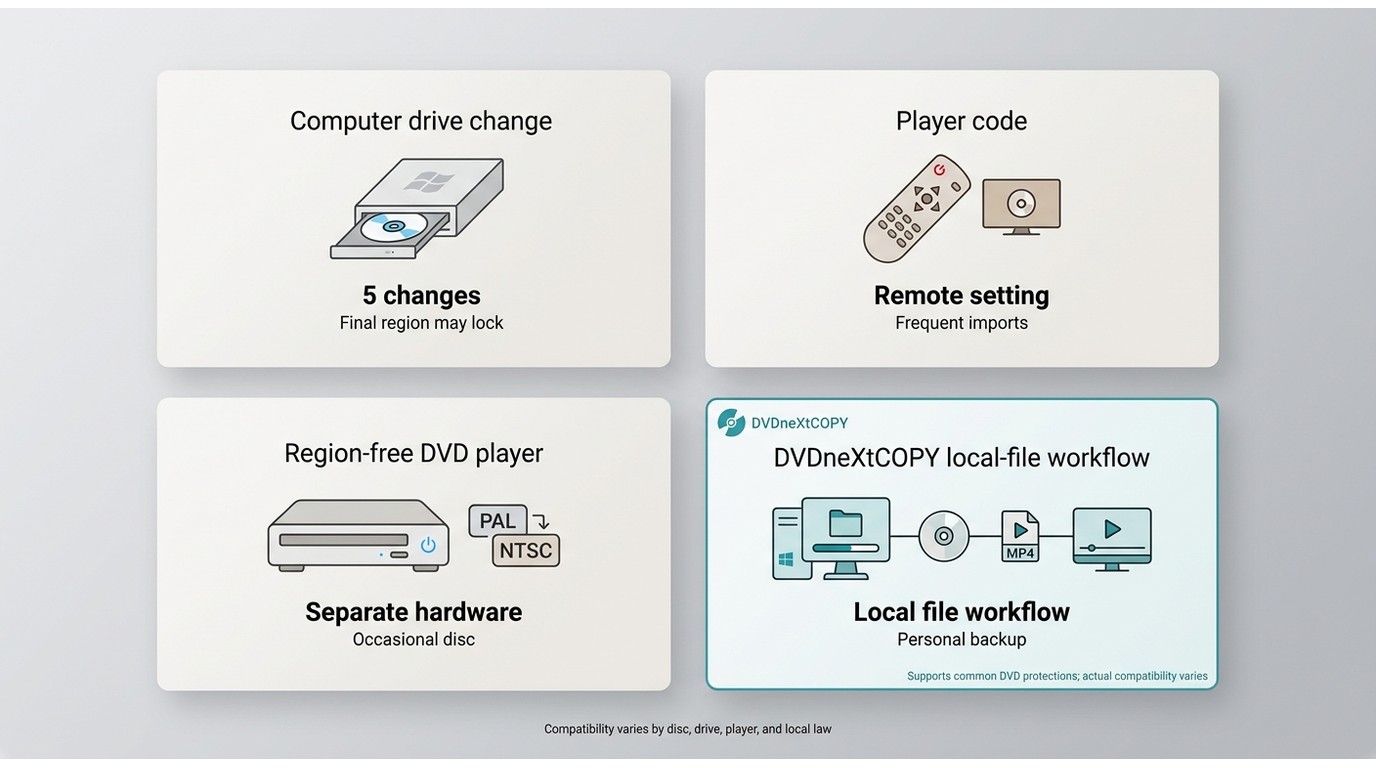
DVD region issues have several possible solutions. Start with the option that makes the smallest change to your current setup.
Drive Region Changes
Many computer DVD drives permit only five region changes, after which the final selected region may become fixed. That can be a poor fit for a mixed-region library, since changing a drive for one imported disc can limit later playback choices.
Player Codes and Region-Free Hardware
A DVD unlock code is model-specific, and some sequences require the original remote. A region-free DVD player can be more practical for frequent imports, but confirm the exact model, supported DVD regions, and PAL/NTSC output before buying.
| Method | Best for | Main limitation | Device impact |
|---|---|---|---|
| Computer drive change | One occasional disc | Final region may lock | Changes drive setting |
| Model-specific player code | Documented compatible player | Code varies by model | Changes player setting |
| Region-free DVD player | Frequent imported DVDs | Check video standards | Uses separate hardware |
| DVDneXtCOPY local-file workflow | Authorized repeat viewing | Requires a Windows computer | Saves a local file |
DVDneXtCOPY DVD Ripper is a Windows app that imports protected DVD discs, ISO files, and DVD folders and can save MP4 or MKV files with subtitle selection and SRT extraction. It is most relevant when you want repeat local playback without changing a drive setting.
- Remove Region Code and many other DVD copy protections for personal conversion.
- Saves common outputs such as MP4 and MKV, with subtitle selection and SRT extraction.
- Supports GPU hardware acceleration; processing time depends on the computer, drive, and output settings.
- Batch mode can queue multiple DVD conversion tasks.
- Basic editing tools let you trim clips, add a watermark, or adjust the output before saving.
DVDneXtCOPY DVD Ripper Workflow
Step 1: Install the DVDneXtCOPY Program and Load the Disc
Open the official website on a Windows PC, install the software, and launch it. Select Ripper in the sidebar, then load a legally owned DVD with the + icon. The disc titles appear in the main window. This follows the same basic actions covered in how to rip a DVD.

Step 2: Select the Output Profile
After the DVD loads, select an output profile that matches where you plan to play the local file. Choose MP4 or MKV for common video playback, then check the title, audio track, and subtitle choices before continuing.

Step 3: Tailor Your Preferred Settings
Open Advanced Settings to review the available video settings. Use the preview and subtitle options to check what will be included. If the selected profile is not right for your playback device, return to the profile list and change it before saving.

Step 4: Begin the Conversion
Choose the storage location at the bottom of the interface, then select Start to save the local copy. Open the finished file in your usual media player and check the picture, selected audio, and subtitles before removing the disc.
Use this option only for personal backups and viewing of legally owned discs, where permitted by local law. Do not publicly distribute, resell, or provide copied content to others.
FAQs
Q
1. Can I change my computer's DVD drive region?
Many computer DVD drives allow a limited number of region changes. In Windows, open Device Manager, select the DVD drive, open Properties , and check the DVD Region tab. Many drives permit only five changes, after which the final selected region may become fixed. Check the remaining change count before selecting a new region.
A
Q
2. Do DVDs and Blu-rays use the same region codes?
No. DVDs generally use numbered regions, while Blu-ray discs use a separate letter-based system. A player described as region-free for DVDs is not automatically region-free for Blu-ray discs, so check the format and exact model before purchase.
A
Q
3. Can DNS change a physical DVD's region code?
No. DNS settings affect network routing, not the region flag on a physical DVD or the optical-disc region setting on a player.
A
Q
4. Will a region-locked DVD play on a PS5?
DVD playback remains region-sensitive. A region-locked DVD may not play on a PS5 from a different DVD region, so match the disc region with the console's DVD playback region before buying.
A
Q
5. What should I verify before buying a region-free DVD player?
Check the exact model's supported DVD regions, PAL/NTSC output, return terms, and whether the listing applies to DVDs, Blu-ray discs, or both. A vague multi-region claim is not enough.
A
Conclusion
Start by identifying the DVD region on the disc or case, then check PAL/NTSC compatibility separately and confirm what your exact player supports. A computer-drive change, a documented player code, verified region-free hardware, or a local-file workflow can each make sense in different situations. For legally owned discs and personal viewing where local law permits, DVDneXtCOPY DVD Ripper is the local-file option when you want repeat playback without changing the drive setting.
![Top 8 Best MP4 to DVD Converters on Windows & Mac [2026 Tested]](https://images.dvdnextcopy.com/2026/09/17/I2v69nzxIF6Xn7iue3ZRMGJ5-Ls0SF_z/feature_cover.jpg) Luna MillerSep 21, 2026
Luna MillerSep 21, 2026Top 8 Best MP4 to DVD Converters on Windows & Mac [2026 Tested]
![How to Remove DVD Copy Protection: Software and Free Methods [2026]](https://c.dvdnextcopy.com/media/How_to_Remove_DVD_Copy_Protection_d24c38a790.png) Steven VanceSep 21, 2026
Steven VanceSep 21, 2026How to Remove DVD Copy Protection: Software and Free Methods [2026]
 Luna MillerSep 21, 2026
How to Rip a Copy-Protected DVD on Win & Mac: 6 Ways
 Steven VanceSep 18, 2026
Top MP4 to ISO Converter in 2026: DVD Authoring vs Online Tools
 Steven VanceSep 18, 2026
How to Digitize DVD Collection: 5 Ways in 2026
 Steven VanceSep 17, 2026
3 Best Free DVD Maker Tools for Playable DVDs in 2026