 DVDneXtCOPY Blu-ray Ripper
2026 Tested Tools to Rip Blu-ray to MP4 on Windows and Mac

Summary: Commercial Blu-ray discs are commonly copy protected, so the right Blu-ray to MP4 method depends first on whether the source can be opened. DVDneXtCOPY Blu-ray Ripper is the primary direct method for supported protected discs. HandBrake works well with readable or unprotected sources, MakeMKV plus HandBrake provides a two step archive and compression workflow, and DVDFab HD Decrypter covers certain older protected discs for free.
Table of Contents
I still prefer Blu-ray when I want a physical copy with good picture and audio quality, but a disc is not always the most convenient way to watch a movie on a laptop, phone, media server, or while traveling. Converting Blu-ray to MP4 solves that access problem, but the process is not the same for every disc.
An unprotected Blu-ray can be encoded with a free tool such as HandBrake, while a commercial disc may need software that can read its protection first. In this guide, I'll walk through what to check before ripping a Blu-ray, compares four Blu-ray to MP4 converters, shows the steps for each, and explains how to choose practical MP4 settings.
What You Need Before Ripping Blu-ray to MP4
Before choosing a Blu-ray to MP4 converter, check the source, optical drive, available storage, and the type of MP4 you want to create. The most important difference is whether the Blu-ray is already readable or still protected.
| Requirement | What to Check |
| Blu-ray drive | A DVD only optical drive cannot read a physical Blu-ray disc. |
| Source type | Blu-ray disc, ISO image, Blu-ray folder, or an existing readable rip. |
| Disc protection | Commercial Blu-rays are commonly protected. HandBrake does not decrypt Blu-ray copy protection by itself. |
| Storage space | Keep enough free space for the source, temporary files, an intermediate MKV when required, and the final MP4. |
| MP4 codec | Decide whether broad compatibility or storage efficiency matters more. Detailed H.264 and H.265 guidance is covered later in this guide. |
| Authorization | Process discs you own or are authorized to use and follow the copyright rules applicable in your location. |
Quick Comparison of the Best Blu-ray to MP4 Converter in 2026
The four methods below can all lead to an MP4 file, but they do not start from the same type of Blu-ray source. The comparison below focuses on these practical differences among each software.
| Comparison | DVDneXtCOPY Blu-ray Ripper | HandBrake | MakeMKV + HandBrake | DVDFab HD Decrypter |
| Protected Blu-ray | Yes, supports common commercial protections | No native decryption | MakeMKV handles supported protected sources first | Older supported Blu-ray protections |
| Direct MP4 | Yes | Yes | No, MKV is created first and encoded to MP4 second | Yes |
| MP4 Codec Options | H.264, H.265 and other MP4 profiles | H.264, H.265 and supported hardware encoders | H.264 or H.265 during the HandBrake stage | Limited free MP4 profiles |
| Audio and Subtitles | Selectable | Selectable | Selectable during the workflow | Selectable |
| Video Editor | Yes, crop, trim, merge, watermark, subtitles and picture adjustments | No dedicated editor; includes crop, resize and video filters | No dedicated editor | Yes, crop, trim, rotate, merge, watermark, subtitles and color adjustments |
| GPU Acceleration | Yes | Yes, on supported hardware | Available during the HandBrake encoding stage | No in the free HD Decrypter mode |
| Systems | Windows | Windows 10 or later, macOS 10.13 or later, Linux | Windows, macOS, Linux | Windows 11, 10, 8.1, 8, 7, and macOS 12 or later |
| Free Use | 30 day full trial | Free | MakeMKV beta or registration rules apply | Free |
| Best For | Direct commercial Blu-ray to MP4 | Readable or unprotected Blu-ray to MP4 | Archive first, compress second | Older supported commercial Blu-rays |
How to Rip Protected Blu-ray to MP4 with DVDneXtCOPY Blu-ray Ripper
- Supported systems: Windows
- Input: Blu-ray disc, ISO image, Blu-ray folder
- Protected Blu-ray: Supports common protections including AACS, BD+, BD-J, and region codes
- Output: MP4 and other supported video and audio formats
- Customization: Titles, audio, subtitles, Advanced Settings, Video Editor, subtitle extraction, preview, and GPU acceleration
DVDneXtCOPY Blu-ray Ripper is the software I would use when I want to convert a protected Blu-ray disc, ISO image, or Blu-ray folder directly to MP4 without first creating a large intermediate MKV file. It supports a range of Blu-ray copy protections and provides multiple MP4 profiles, including H.264 and H.265, which gives me more flexibility when choosing the output for different playback or storage needs. I can also adjust resolution, frame rate, video quality, audio tracks, and subtitle settings before conversion.
I also find its additional tools useful when I need more than a basic Blu-ray to MP4 conversion. The built-in editor can crop, trim, merge, add watermarks or external subtitles, and adjust brightness, contrast, and saturation. It also includes device profiles, subtitle OCR and extraction to formats such as SRT or IDX/Sub, 2D-to-3D profiles, a preview player, and GPU acceleration. I would mainly use these features when I need extra editing, subtitle, or output control rather than simply choosing the software because it offers a large profile library.
Step 1: Load the Blu-ray Disc, ISO, or Folder
Launch DVDneXtCOPY and select the Ripper module. Insert a physical Blu-ray into a compatible optical drive and allow the software to detect the source, or click Add to load a Blu-ray ISO or folder; you can also drag the source directly into the main window. After analysis finishes, check the selected title and its running time before continuing.

Step 2: Select MP4 and Choose the Main Title
Click the current output profile and choose Choose Other Profile, open the video profiles, and select an MP4 profile. Return to the main window and confirm the movie title, chapter range, preferred audio language, and subtitle track. If you also want bonus features or additional episodes, add those titles separately.

Step 3: Adjust the MP4 Settings and Edit the Video
Open Advanced Settings for the selected MP4 profile and review the codec, resolution, frame rate, video quality or bitrate, audio codec, channel layout, and subtitle settings. If the movie needs editing, click Video Edit to trim sections, crop the frame, add a watermark or external subtitle, merge clips, or adjust picture properties, then preview the result before returning to the Ripper module.

Step 4: Choose the Output Folder and Start Ripping
Click Save to and choose the folder where the MP4 should be stored, then click Start to begin the conversion. When the process finishes, open the output and confirm that the correct movie, audio, subtitles, and running time were included.

How to Convert an Unprotected Blu-ray to MP4 with HandBrake
- Current version: HandBrake 1.11.2
- Supported systems: Windows 10 or later, macOS 10.13 or later, Linux
- Input: Unprotected Blu-ray discs and other readable Blu-ray sources
- Output: MP4, MKV, and WebM
- Blu-ray decryption: No native copy protection removal
HandBrake is the best fit when the Blu-ray source is already unprotected and the main goal is MP4 encoding. Once it can read the source, it provides detailed control over video encoding, constant quality, resolution, frame rate, audio, subtitles, filters, and file size. It is also completely free, which makes it a practical option for home authored discs, unprotected Blu-rays, and readable disc backups.
Its limitation comes before the encoding stage: HandBrake does not remove Blu-ray copy protection. A normal encrypted retail disc may therefore fail before the MP4 settings even become relevant. It is also not a full video editor, although its crop, resize, filters, subtitle controls, and supported hardware encoders provide considerably more control than a basic file converter.
Step 1: Open the Unprotected Blu-ray Source
Insert the unprotected Blu-ray into a compatible drive, launch HandBrake, and select the Blu-ray drive from Source Selection. If the source has already been copied to a readable folder, choose Folder instead. Allow HandBrake to scan the source, then use the Title control to choose the movie or episode by comparing its running time and chapter information.

Step 2: Select MP4 and a 1080p Preset
Open the Summary tab and set Format to MP4, then open the Presets menu and choose a suitable starting point. Fast 1080p30 is a practical general preset, while HQ 1080p30 Surround uses a higher quality target and includes a surround audio setup. Check the source resolution and frame rate before accepting the preset.

Step 3: Configure Video, Audio, and Subtitles
Open the Video tab and choose the required encoder, then review the frame rate and Constant Quality setting. Open Audio to select the soundtrack or languages you want to keep, and use Subtitles to add the required subtitle or forced subtitle track. If you are unsure which video codec to use, see the MP4 settings section below.
Step 4: Select the Destination and Start Encode
Click Browse near the bottom of HandBrake, choose the output folder and filename, confirm that MP4 is still selected, and click Start Encode. When encoding finishes, open the MP4 and check the picture, running time, audio, subtitles, and chapter navigation if you chose to keep it.

How to Rip Protected Blu-ray to MP4 with MakeMKV and HandBrake
- Current versions: MakeMKV 1.18.4 and HandBrake 1.11.2
- Supported systems: Windows, macOS, Linux
- Source workflow: Blu-ray is opened in MakeMKV first
- Intermediate output: MKV
- Final output: MP4 encoded with HandBrake
I prefer the MakeMKV and HandBrake combination when I want two files for different purposes: a large MKV that keeps the selected Blu-ray streams for the library and a smaller MP4 for everyday playback. MakeMKV handles the disc first and saves the selected video, audio, subtitles, chapters, and metadata into MKV without the normal video compression step. I can then reuse that MKV for different HandBrake encodes without reading the Blu-ray again.
The tradeoff is straightforward: this workflow requires more storage and two applications because it creates a large intermediate MKV before the MP4. I would not use it when I only need one MP4 and want the shortest route from disc to file. It makes more sense when I want an archive first and a compressed viewing copy second, or when I expect to create more than one encoded version from the same movie.
Step 1: Open the Blu-ray in MakeMKV
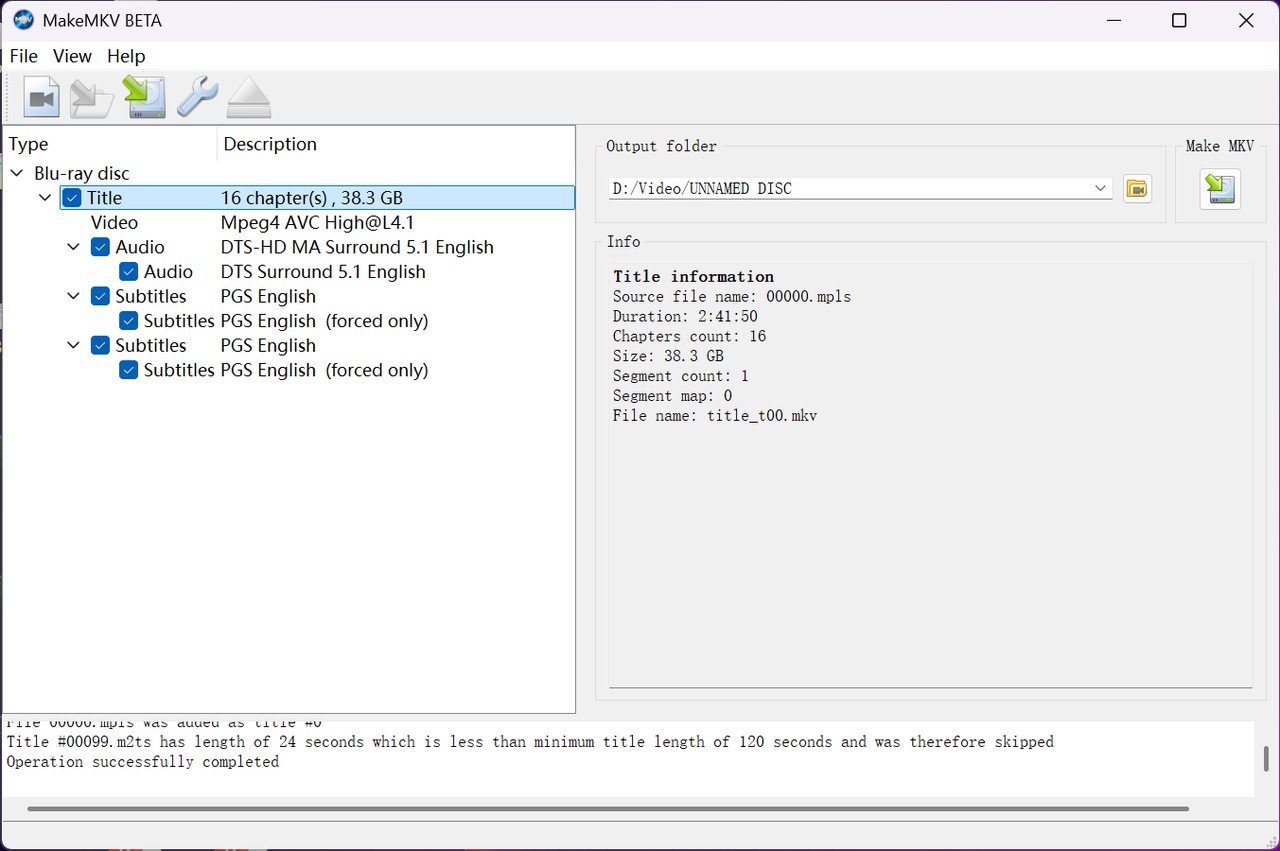
Launch MakeMKV and insert the Blu-ray into the optical drive. On the opening screen, select the drive and click the large disc icon to open the source. MakeMKV will analyze the disc and display the available content as a title tree. If you are working from a supported source already stored on the computer, open that source instead and wait until title analysis is complete.
Step 2: Select the Movie and Create the MKV
In the title tree, uncheck titles you do not need and select the movie or episode you want to convert. Expand that title and remove unnecessary commentary tracks, audio languages, or subtitles while retaining anything you may want later. Choose an output folder and click Make MKV, then open the completed file briefly to confirm that the correct movie and tracks were selected.
Step 3: Open the MKV in HandBrake and Select MP4
Launch HandBrake and drag the MKV into the window or choose File from Source Selection. After HandBrake scans the MKV, open the Summary tab, set Format to MP4, and choose an appropriate 1080p preset as the starting point for the encode.
Step 4: Configure the Encode and Create the MP4
Open the Video tab and choose the required encoder, then review the quality and frame rate settings. Confirm the audio and subtitle tracks imported from the MakeMKV file, click Browse to choose the destination, and select Start Encode. Keep the original MKV if you want it as an archive and remove it only after the MP4 has been checked.
For a more detailed MakeMKV disc workflow, see our guide to using MakeMKV for DVD and Blu-ray.
How to Convert Blu-ray to MP4 for Free with DVDFab HD Decrypter
- Supported systems: Windows 11 and 10, 64 bit; macOS 12 or later
- Input: Blu-ray disc, ISO image, folder
- Protected Blu-ray: Older supported Blu-ray protections
- Output: MP4 and MKV in the free ripping workflow
- Cost: Free
DVDFab HD Decrypter is a free Blu-ray to MP4 converter that supports certain older protected Blu-rays without requiring the MakeMKV and HandBrake two step workflow. It can load supported DVD and Blu-ray discs, ISO images, and folders, select the movie, audio, and subtitles, and use the MP4 or MKV profiles available in the free mode.
The limitation is more important than the feature list. HD Decrypter does not provide the same protection coverage or profile range as the full Blu-ray Ripper, so an older disc is not automatically guaranteed to work simply because it was released more than one year ago. If a disc cannot be opened, the first thing to check is whether its protection falls inside the free support scope rather than changing MP4 settings.
Step 1: Open Ripper and Load the Blu-ray
Launch DVDFab and select Ripper. Insert the Blu-ray into the optical drive and wait for it to load, or click Add to select an ISO image or Blu-ray folder already stored on the computer. If the source is recognized by the free HD Decrypter mode, allow analysis to finish before continuing.
Step 2: Select the Title, Audio, and Subtitles
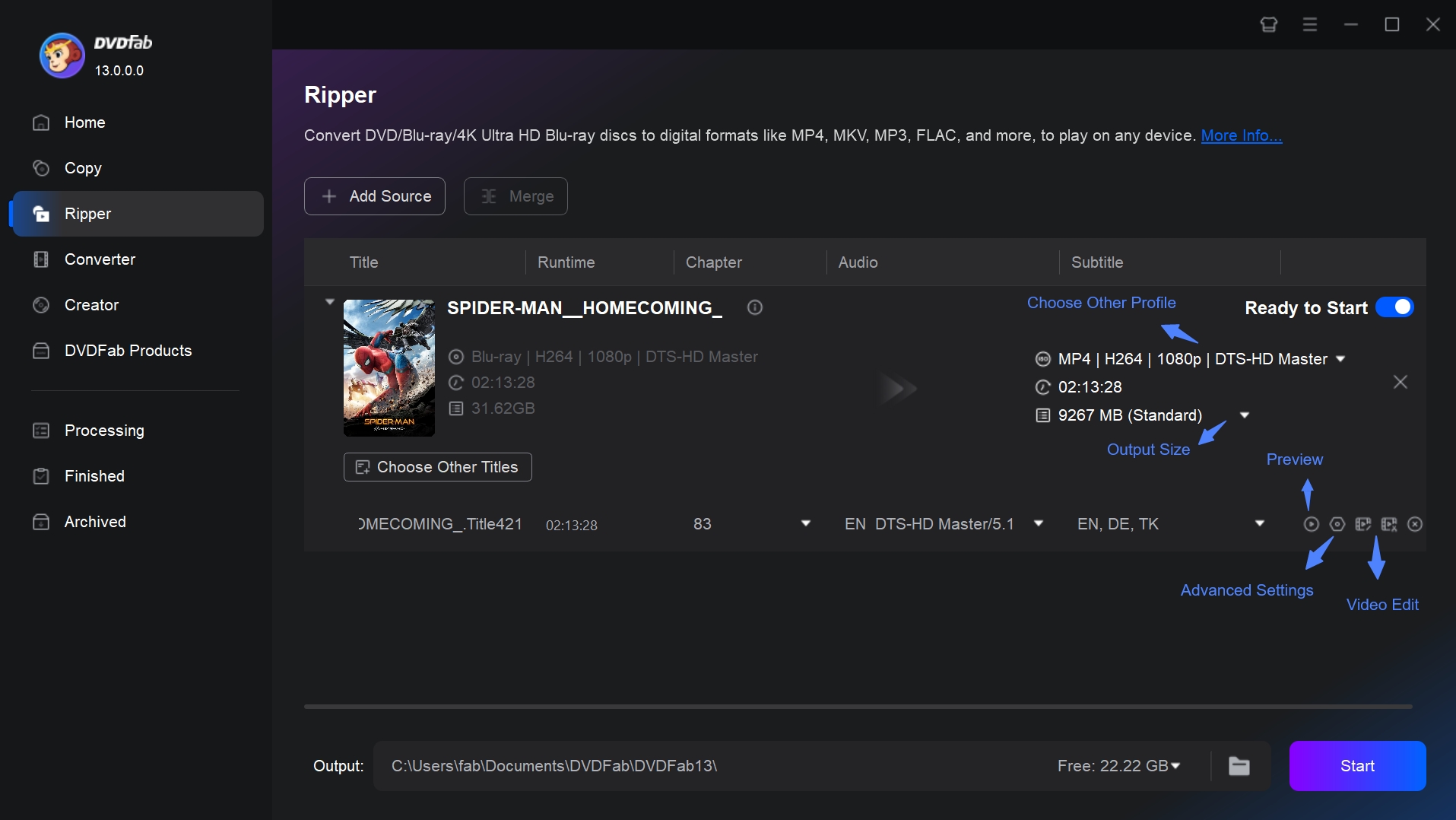
Use the title selector on the source card to choose the main movie or another title, then review the chapter range, audio tracks, and subtitles. Keep the soundtrack and subtitle languages you need, and add an external subtitle file through the available subtitle control if required.
Step 3: Choose an MP4 Profile and Adjust Settings
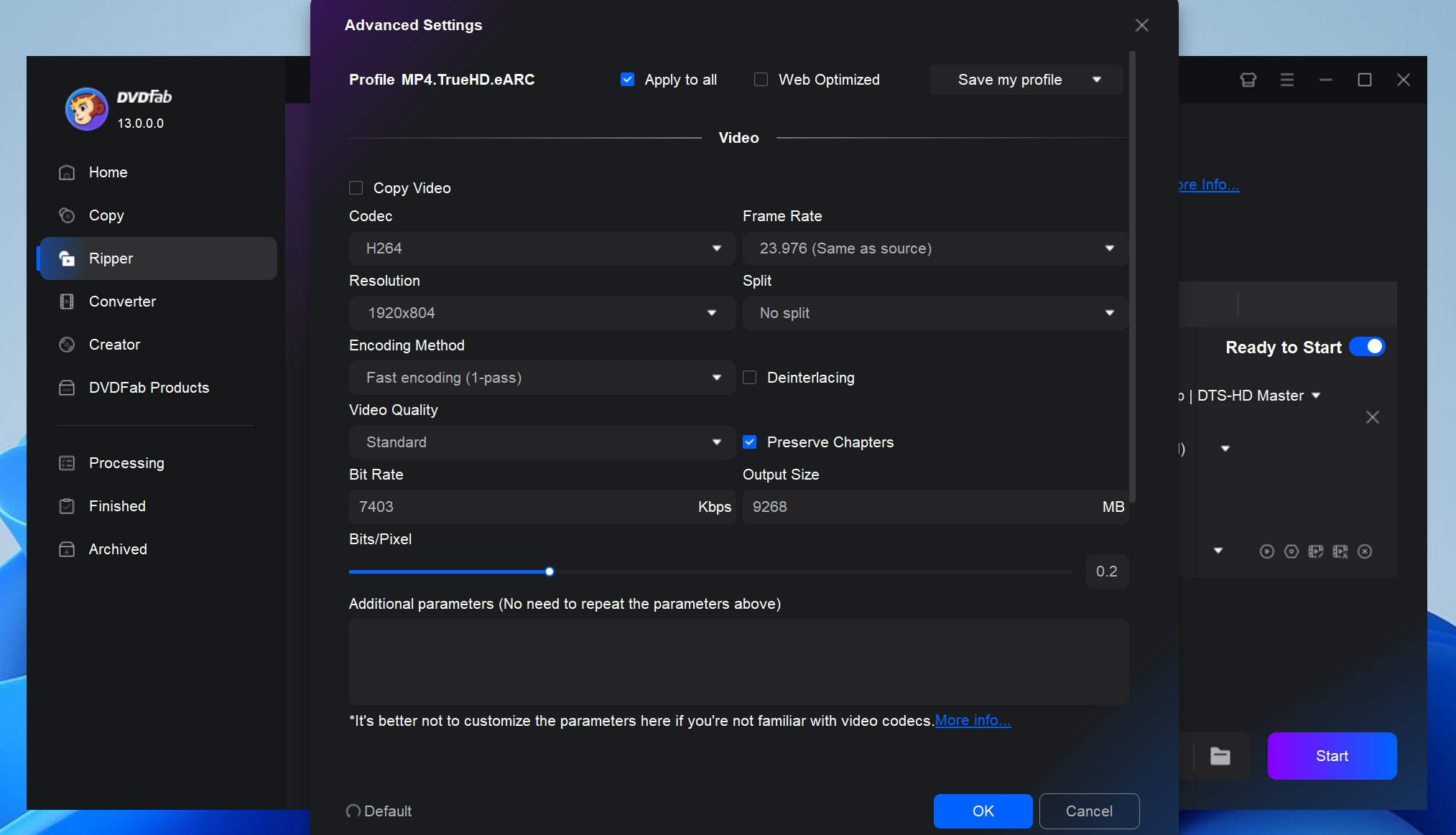
Click Choose Other Profile, open the format section, and select an MP4 profile available in the free mode. Open Advanced Settings if you need to adjust the available resolution, frame rate, video quality, audio, or other encoding parameters.
Step 4: Choose the Output Folder and Start
Select the destination folder at the bottom of the interface and click Start. When conversion finishes, open the MP4 and confirm that the intended title, audio, subtitles, and running time are present.
Best MP4 Settings for Blu-ray Ripping
MP4 is the container, while the video codec, resolution, quality target, audio settings, and selected tracks determine most of the final file size and playback compatibility. Instead of using one preset for every disc, choose the settings according to how and where the MP4 will be used.
| Goal | Video Codec | Resolution | Setting Direction | Best For |
| Broad compatibility | H.264 | 1080p | Moderate compression | TVs, phones, consoles, older hardware |
| Smaller file | H.265 | 1080p | Stronger compression at a similar visual target | Modern TVs, Plex, NAS |
| Editing | H.264 | Source resolution | Higher quality target | Video editing applications |
| Portable copy | H.264 or H.265 | 720p or 1080p | Stronger compression | Tablets and laptops |
H.264 or H.265 for Blu-ray to MP4?
Choose H.264 when compatibility matters most. It remains a safer choice for older televisions, phones, tablets, game consoles, browsers, and editing applications. Choose H.265 when storage efficiency matters more and the target devices support HEVC. At a similar visual target, H.265 can generally produce a smaller file, but encoding is more demanding and older playback hardware may not support it smoothly.
Which Audio and Subtitles Should You Keep?
Keep the audio languages you actually use rather than carrying every soundtrack from the Blu-ray into the MP4. Multi channel or lossless audio can add substantial size, so decide whether the target playback system needs those tracks. Subtitle handling depends on the program and output profile, and forced subtitles deserve particular attention because they may contain only foreign language dialogue within an otherwise English soundtrack.
FAQs
Usually yes if the Blu-ray video is reencoded to H.264 or H.265. Reencoding can make the MP4 much smaller than the original Blu-ray source, but it may also introduce some quality loss. The final size depends mainly on movie length, resolution, codec, bitrate or quality setting, and the audio tracks you keep. H.265 can generally reach a smaller file than H.264 at a similar visual target, while higher quality settings and additional audio tracks increase the output size.
Blu-ray discs commonly use image based PGS subtitles, and not every MP4 workflow can preserve those subtitles as selectable tracks. In HandBrake, for example, PGS subtitles cannot be passed directly into an MP4 and must be burned into the video if you want to keep them. Another option is to convert the subtitles to a compatible text format such as SRT when the ripping software provides subtitle OCR or extraction tools.
Yes, when the conversion software and MP4 workflow support chapter markers. HandBrake, for example, can copy chapter markers detected in the source into an MP4 output file. Chapter handling varies by software and player, so check the chapter list before encoding if navigation points are important.
Yes, but UHD Blu-ray has different drive and protection requirements from standard Blu-ray. You need a UHD compatible optical drive and software that supports UHD processing. A normal Blu-ray drive is not automatically able to read UHD discs. See our 4K Blu-ray ripping guide for the dedicated workflow.
Conclusion
The right Blu-ray to MP4 converter depends first on the source rather than on the number of output formats a program advertises. For a supported protected commercial Blu-ray and a direct disc to MP4 workflow, DVDneXtCOPY Blu-ray Ripper is the primary choice because disc access, title selection, MP4 encoding, editing, subtitles, and output settings are handled in the same application.
HandBrake is the better free option when the Blu-ray is already unprotected or otherwise readable. MakeMKV plus HandBrake makes more sense when I want to keep a larger MKV archive before creating a smaller MP4, while DVDFab HD Decrypter provides a free direct route for certain older commercial Blu-rays that fall within its supported protection range.
 Steven VanceSep 17, 2026
How to Rip Blu-ray on Mac in 2026: 4 Workflows, 5 Methods
![How to Rip 3D Blu Ray: Pick MVC or SBS Before You Start [2026]](https://images.dvdnextcopy.com/2026/09/15/OCieIQbnp92l67jxKZzrGV_sFMToZiaa/feature_cover.jpg) Steven VanceSep 16, 2026
Steven VanceSep 16, 2026How to Rip 3D Blu Ray: Pick MVC or SBS Before You Start [2026]
 Steven VanceSep 15, 2026
Convert BDMV to MP4 on Windows or Mac: Choose the Right Method
 Luna MillerSep 15, 2026
How to Convert BDMV to MKV in 2026: Folder, Remux, or Re-Encode?
 Luna MillerSep 15, 2026
Blu-ray Authoring Software for Windows and Mac: 2026 Picks by Project
 Luna MillerSep 8, 2026
Best Free Blu-ray Copy Software in 2026: Reviews & How-to Guide